
Dahshur Pyramids, Egypt: The Bent Pyramid, the Red Pyramid and Their History
Architecture, religion and royal power – from the first experiments to the perfection of Egypt's pyramids
Among Egypt's great pyramid fields, one site stands out for its importance in the history of pharaonic architecture: Dahshur. This ancient necropolis, about 40 kilometres south of Cairo on the west bank of the Nile, holds some of the most important monuments of ancient Egypt. The Dahshur pyramids should not be seen merely as a lesser-known alternative to Giza. Dahshur was a true centre of architectural and religious experimentation, where Egyptian builders developed solutions that changed pyramid construction forever.
In this guide, Sharara Tours introduces the main pyramid complexes of Dahshur, their history, architecture and religious meaning. We focus in particular on the Bent Pyramid and the Red Pyramid of Sneferu, followed by the Middle Kingdom monuments built during the 12th Dynasty.
Dahshur, Egypt – location and landscape
Dahshur was not chosen as a royal necropolis by chance. The plateau on the western edge of the desert offered ideal conditions for building monumental stone structures. It also formed a symbolic boundary between the world of the living, tied to the Nile Valley, and the land of the dead in the desert. This contrast was deeply rooted in Egyptian funerary beliefs and in the symbolism of the west – the direction of the setting sun and the passage to the afterlife.
Archaeological evidence shows that the Dahshur area was already in use during the earliest dynasties. However, its most spectacular pyramid complexes were built at the beginning of the 4th Dynasty, during the Old Kingdom. The site stretches for several kilometres from north to south and includes monuments from different periods of pharaonic history.
Pharaoh Sneferu and the start of a revolution in pyramid building
2.1 Pharaoh Sneferu – his reign and its significance
Sneferu, founder of the 4th Dynasty and an Old Kingdom ruler, holds a special place in the history of Egyptian architecture. Later sources, including the Westcar Papyrus, portray him as an approachable king close to his subjects. Above all, however, his reign is associated with exceptionally intensive building activity. Several pyramid projects are attributed to him, including at Meidum and especially at Dahshur, where the Bent Pyramid and the Red Pyramid were built.
The scale of Sneferu's building projects was immense and shows the remarkable organisational and technical skills of the ancient Egyptians. These projects played a decisive role in the architectural developments that, one generation later, led to the great pyramids of Giza.
The Bent Pyramid of Sneferu at Dahshur
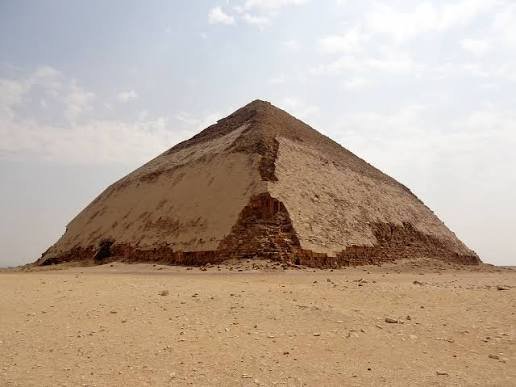
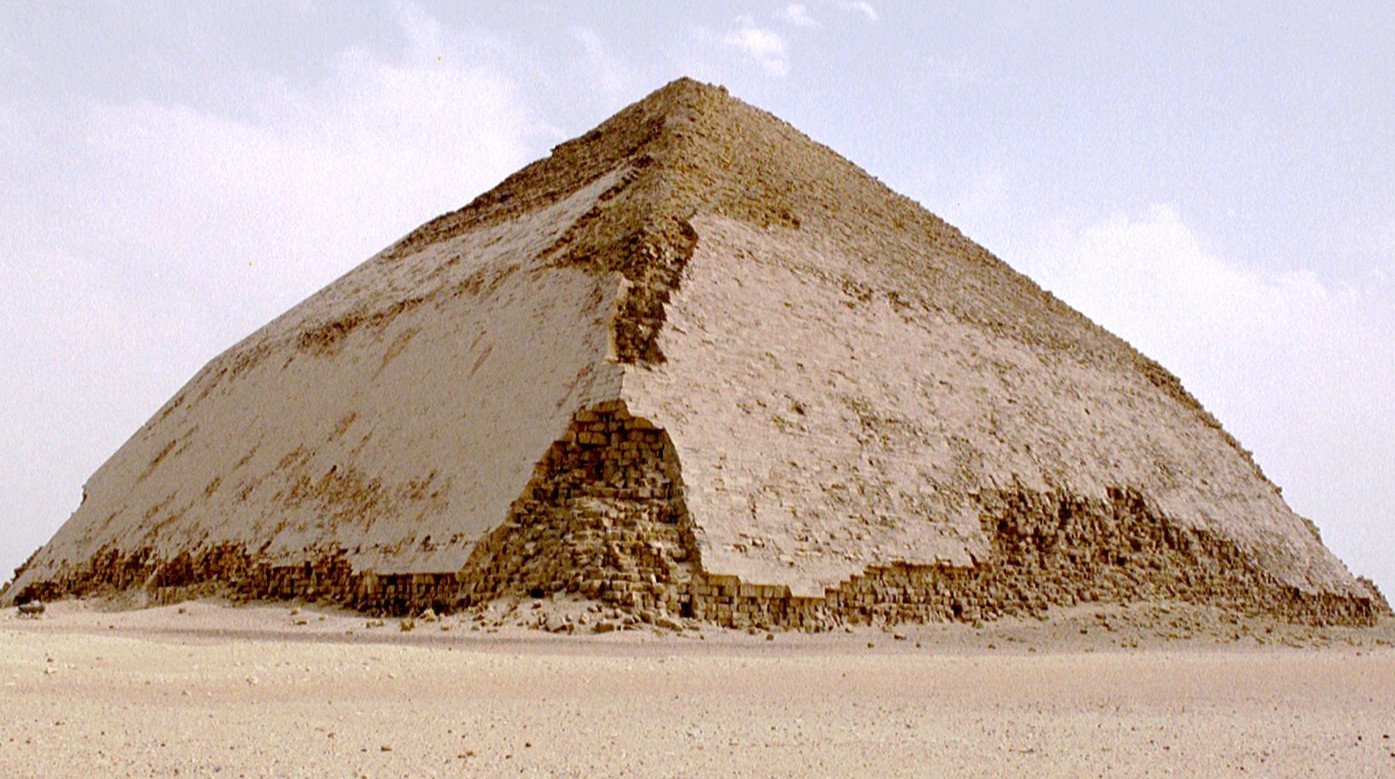
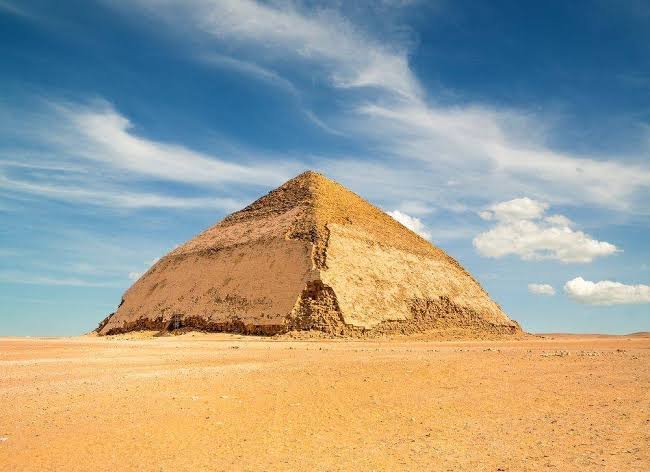
The Bent Pyramid at Dahshur is one of the most unusual monuments of ancient Egypt. Its silhouette immediately reveals its defining feature: at a certain height, the angle of its sides changes clearly – from about 54° to almost 43°. This change gives the pyramid its distinctive profile and its modern name.
The exact reasons for the change of angle are still debated. The most widely accepted theory is that, during construction, the builders decided the original angle was too steep. Problems with stability or weaknesses observed in the structure may have led them to reduce the slope and lighten the load on the upper part of the pyramid.
The Bent Pyramid is about 105 metres high, with a base side length of about 188 metres. Its largely preserved outer casing of white limestone is particularly impressive. Thanks to it, you can imagine the smooth, bright appearance of the great pyramids in the time of the pharaohs.
The interior is just as exceptional. The pyramid has two independent entrance systems – one from the north and one from the west. Its main chambers are roofed with corbelled vaults, designed to distribute the weight of the stone. This solution shows the advanced technical knowledge of Sneferu's builders.
The Red Pyramid at Dahshur – the first successful smooth-sided pyramid
North of the Bent Pyramid rises the Red Pyramid at Dahshur. Its modern name comes from the reddish tone of its limestone, especially visible in the desert light. Built during the reign of Sneferu, it marks a turning point in the history of Egyptian pyramids.
The Red Pyramid has a base side length of about 220 metres, and its original height was almost 104 metres, making it one of the largest pyramids in Egypt. Its importance lies above all in its construction: it is widely regarded as the first large smooth-sided pyramid to be successfully completed. Its uniform angle, close to that of the upper part of the Bent Pyramid, shows that Sneferu's architects learned from their earlier projects.
The interior of the Red Pyramid has a clear layout. Three connected chambers, roofed with tall corbelled vaults, form the heart of the monument. The arrangement of the burial chambers reflects the evolution of Old Kingdom architectural and ritual concepts.
Religiously, the pyramid was linked to the transformation and rebirth of the king after death. The northern orientation of some elements also refers to the circumpolar stars, which Egyptian beliefs associated with eternity and everlasting existence.
The religious and cosmological meaning of the Dahshur pyramids
Looking at the pyramids only from an architectural point of view would not be enough. In ancient Egypt, these monuments were more than tombs. They were part of an elaborate system of rituals designed to ensure the dead king's transformation and passage into the world of the gods.
The Pyramid Texts, inscribed in royal tombs from the late Old Kingdom, preserve older religious traditions. They describe the dead king rising to the sky, his union with the sun god Ra and his place among the stars. The pyramid shape itself can also be linked to solar symbolism and to the benben stone of Heliopolis, associated with the primeval mound of creation.
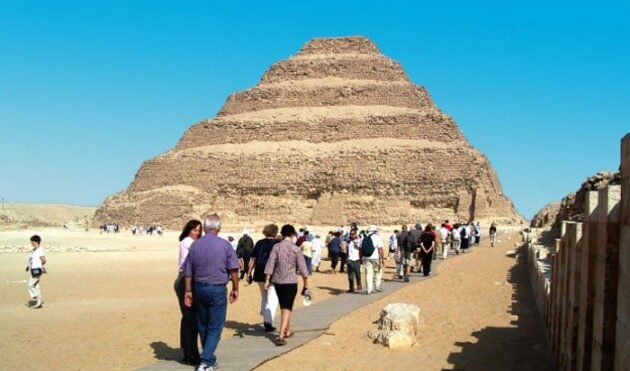
In this context, the move from the step pyramid to the smooth-sided pyramid was not just technical progress. It also reflected a change in the religious and symbolic language of royal architecture. Dahshur is one of the most important places to observe this evolution.
Middle Kingdom pyramids at Dahshur
4.1 The Middle Kingdom and the pharaohs' return to Dahshur
After the end of the Old Kingdom and the First Intermediate Period, several 12th Dynasty rulers once again chose Dahshur for their royal burials. Returning to Sneferu's necropolis may have symbolically emphasised continuity with the great rulers of the past and strengthened the legitimacy of the Middle Kingdom pharaohs.
4.2 The Black Pyramid of Amenemhat III
One of the most distinctive Middle Kingdom monuments at Dahshur is the Black Pyramid of Amenemhat III. Its mudbrick core, now heavily eroded, contrasts with the grandeur of the original complex. The famous dark stone pyramidion associated with this monument, decorated with inscriptions and religious symbols, shows the sophistication of royal architecture at the time.
The Black Pyramid has a particularly complex interior with corridors, chambers, shafts and blocking mechanisms. This layout reflects the development of funerary practices and the growing need to protect royal burials from tomb robbers.
4.3 The pyramids of Amenemhat II and Senusret III
Amenemhat II and Senusret III also built funerary complexes at Dahshur. The pyramid of Senusret III is especially interesting for the layout of its underground rooms. Tombs of royal women containing jewellery of exceptional quality were discovered nearby.
The finds made by Jacques de Morgan in the late 19th century, often called the Dahshur treasure, include remarkable pectorals, diadems and bracelets.
The history of archaeological research at Dahshur
Systematic research at Dahshur began in the 19th century. Karl Richard Lepsius visited the site during the Prussian expedition of 1842–1845 and helped document it. In the 1890s, excavations led by Jacques de Morgan uncovered several Middle Kingdom treasures. In the 20th and 21st centuries, Egyptian and international archaeological missions greatly expanded our knowledge of the necropolis.
Research on the Bent Pyramid, its associated temples and various burial areas has improved our understanding of building methods, the organisation of royal complexes and the development of Dahshur over successive dynasties. Today, studies of pottery, stratigraphy and cult places complement research on the monumental buildings themselves.
Dahshur, Saqqara and Giza – how did Egyptian pyramid architecture evolve?
To understand the evolution of the pyramids, you need to look at three key sites: Saqqara, Dahshur and Giza. Saqqara shows the first major stages of monumental funerary architecture (read our guide to the Saqqara pyramids). Giza represents the peak of royal pyramid building in the 4th Dynasty. Between them, Dahshur holds a special place – this is where key architectural solutions were tested and gradually perfected.
Without the experience gained while building Sneferu's pyramids at Dahshur, and the changes made during these huge projects, the design of the Great Pyramid of Khufu at Giza would probably have developed differently. Dahshur is therefore a fundamental stage between the first pyramids and the monumental masterpieces of Giza.
Visiting the Dahshur pyramids – practical tips
Getting there: Dahshur lies about 40 km south of Cairo. Most travellers visit by private car as part of a day tour that also includes Saqqara and Memphis, such as our Saqqara, Memphis and Dahshur day tour from Cairo.
Fewer crowds: Dahshur is usually much quieter than Giza, so you can enjoy the pyramids in a peaceful desert setting.
Going inside: entering a pyramid involves a long, steep and narrow descending passage. Wear comfortable shoes and take your time. Access to individual monuments can change, so check the latest information before your visit.
Best time: October to April is the most comfortable period; arrive early in the morning to avoid the midday heat. Visiting with a professional English-speaking Egyptologist guide helps you understand how each pyramid fits into the bigger story.
Why should you see the Dahshur pyramids near Cairo?
The Dahshur pyramids are much more than a preparatory stage for Giza. The Bent Pyramid reveals the technical experiments of Sneferu's builders. The Red Pyramid is the culmination of that process and one of the most important milestones in the history of pyramid architecture. The Middle Kingdom monuments, in turn, show that Dahshur kept its prestige for many centuries.
A visit to Dahshur lets you trace the development of Egyptian pyramid architecture almost first-hand. In this desert landscape, Sneferu's monuments stand alongside Middle Kingdom remains, telling a story of centuries of innovation, royal power and funerary belief. For travellers interested in history and Egyptology, Dahshur is one of the most rewarding archaeological sites to visit during a stay in Cairo. Discover more ideas among our Cairo tours.
Dahshur pyramids – frequently asked questions
Where are the Dahshur pyramids?
Dahshur is a royal necropolis on the west bank of the Nile, about 40 km south of Cairo and a short drive south of Saqqara.
Why is the Bent Pyramid bent?
The angle of its sides changes from about 54° to almost 43°. The most widely accepted theory is that the builders reduced the slope during construction because of stability concerns.
Why is it called the Red Pyramid?
Its name comes from the reddish tone of its limestone. Built for Sneferu, it is widely regarded as the first successfully completed smooth-sided pyramid.
Is Dahshur worth visiting?
Yes. Dahshur shows the crucial step between the Step Pyramid at Saqqara and the Great Pyramid of Giza, and it is usually far less crowded.
Can you combine Dahshur with Saqqara and Giza?
Yes. Many travellers visit Dahshur, Saqqara and Memphis in one day, or combine Dahshur with the Giza pyramids on a full-day tour from Cairo.
Visit Dahshur with Sharara Tours
Stand before the Bent Pyramid and the Red Pyramid with a professional English-speaking Egyptologist guide. We organise private day tours from Cairo and trips from the Red Sea resorts.
Book now Saqqara, Dahshur and Giza tour